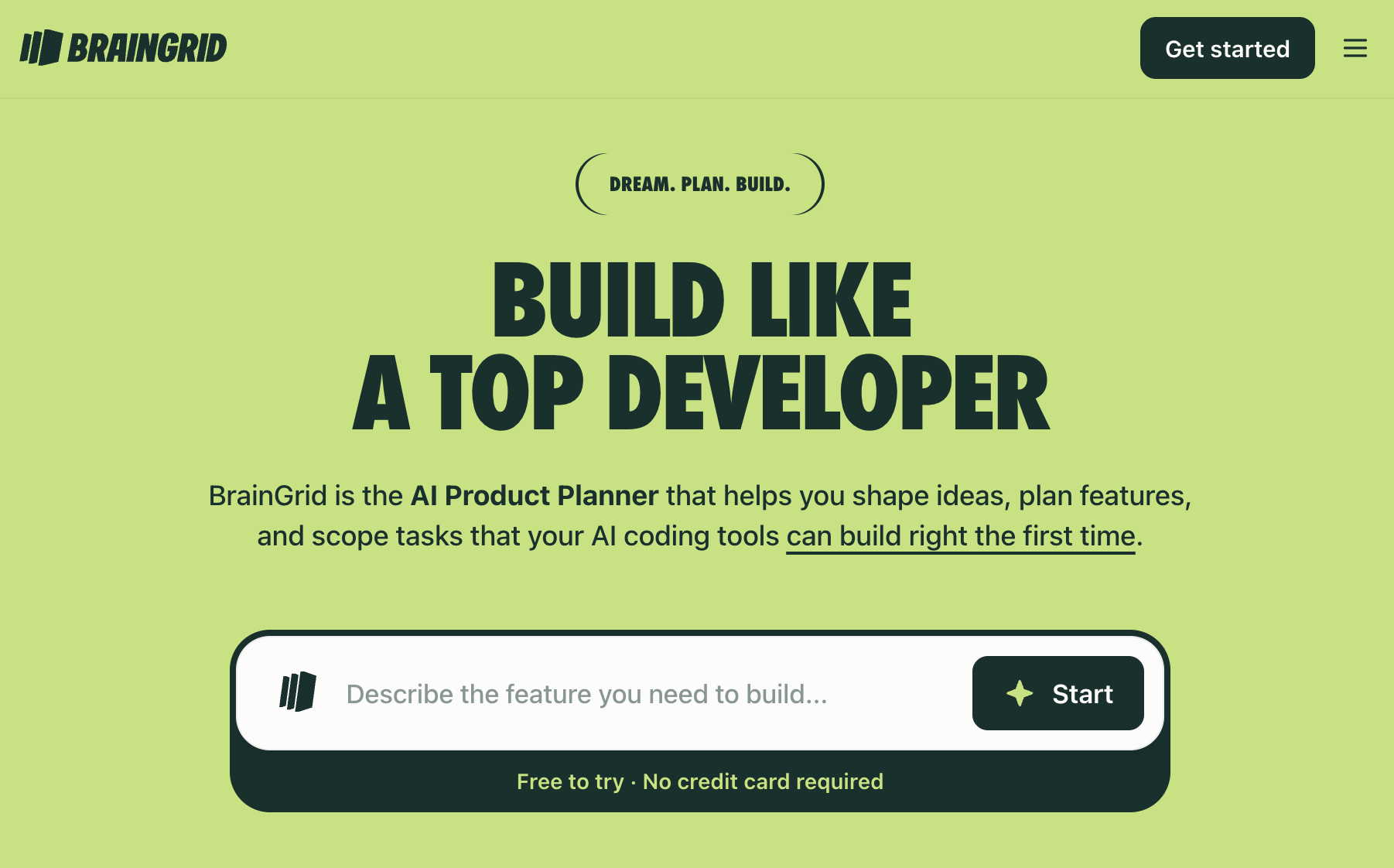
At Next Tier Ventures, we are excited to announce our investment in BrainGrid, the platform that turns product ideas into structured plans for AI-native software development. The company has raised a $1M pre-seed round led by Menlo Ventures, with Brainstorm Ventures joining the round.
BrainGrid is building something we believe will become increasingly important in the new software stack: an AI-assisted product planning layer that turns scattered ideas and requirements into structured plans, ready to be executed by AI coding tools and development agents. BrainGrid positions this category as the AI Product Planner, sitting upstream of coding agents rather than competing directly with them.
The problem: the bottleneck is no longer just coding
The way software is built is changing rapidly. With the rise of code copilots and development agents, generating code is becoming easier, faster, and more accessible. But that does not mean building great products has become trivial.
In our view, the bottleneck is shifting. The ability to write code matters less on its own, while the ability to define the product clearly, structure requirements, prioritize effectively, anticipate edge cases, and provide AI with enough context to execute coherently matters more and more. That core thesis is exactly what drew us to BrainGrid. It aligns closely with how the company frames the problem: code generation is improving quickly, but planning remains the constraint.
That is where BrainGrid fits in.
What BrainGrid is building
BrainGrid is creating an AI Product Planner for the next generation of builders. Its product helps turn messy ideas, scattered notes, and loosely defined concepts into structured product plans, allowing tools such as Cursor, Claude Code, and other AI coding agents to operate on a much clearer and more actionable foundation. The company explicitly describes BrainGrid as a planning layer that works alongside these tools rather than locking users into a single development environment.
We find this thesis particularly compelling because BrainGrid is not trying to win at the code generation layer, but at the layer before it: thinking clearly about what needs to be built and how it should be organized.
And in an environment where code itself is likely to become increasingly commoditized, that layer can become critical.
Why we believe this category will grow
We are seeing a clear transition: more and more people will be able to launch software, even without being traditional engineers. Founders, business operators, creators, and domain experts will be able to build much more than ever before thanks to AI. BrainGrid is explicitly built around this shift, with a product vision aimed at helping non-technical builders turn ideas into real software products.
But this democratization does not remove the complexity of building useful products. It shifts it.
The challenge is no longer just “coding,” but turning an intention into a specification good enough for the system to produce something functional, coherent, and well designed. And the more agents become involved in the development process, the more important the quality of the input, the sequencing of the work, and the structure of the product will become. That dynamic is central to BrainGrid’s long-term vision, which it describes through the workflow Capture → Structure → Build → Verify.
That is why we believe BrainGrid is addressing a real and growing need.
Early traction with a clear signal
Even at a very early stage, BrainGrid has already helped more than 500 builders ship AI-native SaaS products, according to the company’s announcement. The post also showcases examples ranging from non-technical users to highly experienced engineers, suggesting that the product is already resonating across different user profiles.
That matters to us because it validates something important: this is not a purely theoretical idea. It reflects a pain point that is already emerging in the market.
We also like that the product does not appear limited to a single type of user. It can create value for non-technical builders trying to launch faster, as well as for more technical teams looking to improve planning, requirement quality, and execution flow. That breadth of applicability strikes us as a strong early signal.
Founders with the right perspective to build this layer
Another important reason behind our investment is the founding team.
BrainGrid was founded by Nico Acosta and Tyler Wells, who together bring more than 25 years of experience building software across startups, enterprise teams, and multiple eras of development workflows. That matters in a company like this. BrainGrid is not simply riding the AI coding trend; it is being built by founders who understand, from experience, how bottlenecks in software development evolve over time.
Nico, in particular, brings more than 20 years of Product Management experience, including building developer platforms at Twilio and AWS. That background is especially relevant for what BrainGrid is trying to solve. This is not just about helping AI write code. It is about creating the planning layer that sits before code generation: the layer that helps define what should be built, how it should be scoped, and how AI can execute against a clearer product intent.
What we particularly like about Nico and Tyler is that they are not approaching this opportunity from a superficial view of the trend. Their view appears grounded in a structural understanding of how products are conceived, how requirements are translated into working software, and where the real friction is now emerging in AI-native development workflows.
Why we invested
At Next Tier, we look for companies that do not just use AI, but build meaningful layers of value within the new workflows AI is creating.
BrainGrid fits that thesis very well. It is building a strategic layer in the software creation process: the layer that connects intention with execution. And if the software of the future is increasingly going to be built with agents, we believe that connection will only become more important.
What attracts us is the combination of three elements:
an emerging need,
a clear product thesis,
and founders with the product and platform experience to build this category.
We are excited to back the BrainGrid team at this early stage and to be part of this journey alongside Menlo Ventures and Brainstorm Ventures.